1940 Revere Eight model 88
- Lauren West
- May 13, 2020
- 4 min read

Updated: Apr 6, 2021
When you picture world war era technology, typically people imagine planes, medicine, radar, and nuclear energy. But the arts continued through the war too; today I'm excited to tell you about a WWII movie camera that I have in my collection.
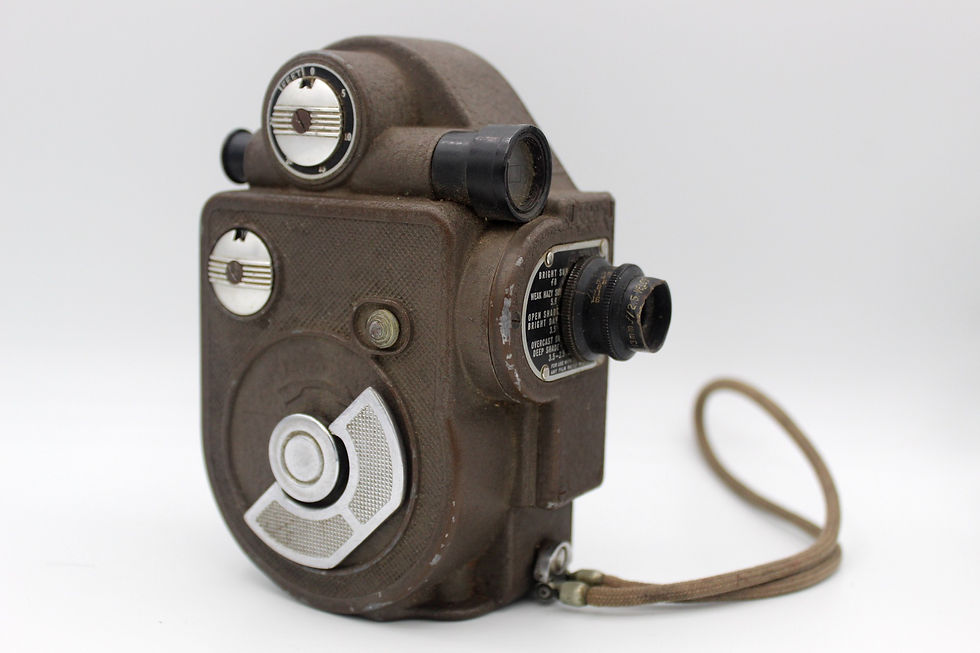
This camera is a Model 88 produced in Chicago between 1940 and 1946. Made by the founder of the Excel Auto Radiator Company, Sam Briskin (born Shulem Boriskin), who began exploring other ventures in 1939, it was branded a Revere Eight because it was made by his second company Revere and took double 8mm film. This film was like regular 16mm film, but would be exposed one side at a time, and then cut and spliced together post-development. The camera itself appears to be in somewhat rough shape cosmetically, although the brown coloring is much like the original advertisements. This camera has a bit of fungus on the lens making it harder to see out of, although all of the mechanics seem to work just fine.
I do not use 8mm film or possess any skills whatsoever in cinematography, so much of this review will be on the structure and mechanisms on the camera body. The camera itself is quite a chunk, as it weighs around 2-3 lbs and is almost exclusively metal.

As far as the lens goes, there are several options for f stops based on the lighting you're in. F stops control the aperture (the diaphragm of the lens, how much light is let in). My lens is a bit bent out of shape, but you can turn the dial on the fixed lens to determine which f stop suits your needs. You can choose from "Bright Sun" at f/8, "Weak Hazy Sun" at f/5.6, "Open Shade/Bright Day" at f/3.5, and "Overcast or Deep Shade" between f/3.5 and 2.5.

On the actual dial itself, more options are presented-- f/2.5, 3.5, 4, 5.6, 8, 11, and 16. You just turn the dial until your desired stop is lined up with the fixed line. The lens itself reads "Wollensack-Revere 13mm f/2.5 Velostigmat." Revere used Wollensak as their independent lens provider until their acquisition of the company in the early 1950s. The mm on a lens refers to the focal length of the shot available. Zoom lenses have a range of mm available (my canon rebel for instance has a focal length of 18-55mm, meaning I can use the zoom to change from wide to shallow angle). The smaller the number on the lens, the wider the angle of the shot. This camera being a 13mm focal length means the lens is fixed at that focal length, and it will shoot fairly wide angle shots. The f/2.5 printed on the lens refers to the maximum f stop available on the camera. For aperture, the smaller the number, the wider the opening to let light in. That's why the "Deep Shade" option has the smallest number-- you want to let in as much light as possible since there won't be much natural light available.
Unfortunately, the dial covers up some of the words on the plate, but based on a similar manual, it reads "FOR USE WITH COLOR FILM OR ANY FILM RATED WESTON 8". Weston 8 was a film speed rating that other companies used when selling film, as seen in this ad from Popular Photography, July 1946:


To operate the camera, first you must open the back lid by moving the metal slider to "open", and the door should swing open on a hinge. The inside looks a bit confusing and daunting to use, but I will endeavor to explain its usage the best I can below.

Now, load the film. This is a difficult process to explain just over text, so I'm including the video below to give you a visual of what you need to do:
Once your film is loaded, you're ready to shoot! Adjust your meter on the front of the camera (left corner above the wind) to 16 for standard 8mm film. The motor is mechanical, so you'll need to crank the wind knob on the front of the camera to get it ready to go. Next, push the small circular button forward above the wind to start the motor. The knob at the very top of your camera is your counter; it tells how many feet you have left in the roll. Once it runs to 0, don't forget to flip the roll to expose the other half of your film. Film labs will slice the film down the middle and put the two halves together to make one 50ft movie.


Below is a sample video I found that was shot with this model of camera. The music is added in post-production-- the film itself does not contain sound.
Overall, I'm not a huge fan of the camera because of it's hefty weight and small viewfinder (coupled with the fact that I don't shoot cinema film), but if you're looking for a steampunk addition to your collection, the Model 88 certainly fits the bill. They're fairly inexpensive and easy to find too.
Quick Facts:
- Manufactured: 1940-46
- Shutter Speed: 1/8 -- 1/32 sec
- Focal Length: 13mm
- Aperture: f/2.5 -- f/16
- Original price: $77.50
- Film type: double 8mm (not Super 8!)
- Shots per roll: 25ft per side, 50ft per roll = ~4mins of film
Advertisements:


Sources:


Hey @Dave Mic3, great question! So by setting the dial above the wind knob to 16, that is setting the frames per second (fps) of the film. 16fps is standard speed for this type of film. For 50ft of film, this equates to about 2 minutes of shooting per side, about 4 minutes total. So if you're looking to shoot a short (silent) YouTube video or give a time capsule a glimpse at what your family pastimes are, it's the perfect length -- anything else, not so much.
You said this shoots a 50ft film, how long is that in time? How long of a movie does this camera make? Great writeup!