1955 Bolsey Jubilee
- Lauren West
- Apr 30, 2020
- 4 min read

Updated: May 19, 2020
I am so excited to tell you about this neat little camera I found while antiquing in Anderson one day! This camera model is interesting because it was actually only manufactured for one year before the business went under. As a result, there aren't a lot of models out there. The condition of mine is a bit rough as the glass plate on the top is missing and certain words are faded and scuffed, but with the carrying case included, and with the widespread availability of 35mm film, it was too good an opportunity to pass up. So now, let me tell about this camera that is among my favorites of my vintage film collection.


Manufactured in 1955, the Bolsey Jubilee has both split-image rangefinder focusing (the smaller of the two squares) and an optical viewfinder. To adjust the focus, the two extruding knobs on either side of the lens need to be pushed or turned until the split images in the rangefinder line up seamlessly. This is how you know the image will be sharp.
On the fixed lens component itself, there are several gauges that need to be lined up to take the perfect shot. It has suggestions for light metering based on the type of film used, including Tri-X, Plus-X, Ektachrome, and Kodachrome-Subject. Each of these film type labels line up with a sky meter with arrows pointing to Dull and Bright (above the Cloudy label), and Hazy and Bright (above the Sunny label). By lining these choices with the film type labels of Lt, Av, Dk (which I believe to stand for Light, Advance, Dark), you can make sure the exposure of your film is accurate.
Now, shutter speed is interesting. There are only a few options for shutter speed, and one of them is B. This option allows the photographer to control the shutter speed by holding down the button as long as desired. My Jubilee did not come with a tripod, but I'm sure some interesting long exposure shots could be made with the right equipment. The other shutter options are 1/200, 1/100, 1/50. 1/25, and 1/10. With that said, because the shutter cannot go faster that 200, it is advised that photos are taken with a somewhat steady hand to avoid blur. The camera recommends that photos are taken at 50, but given that typical ISO of film is around 400, you would need to compensate either on aperture or film to keep the exposure where it needs to be for a well lit photo. Aperture options include f.28, 4, 5.6, 8, 11, 16, and 22.
For the third and last dial on the lens, we come to the Set-O-Matic. This dial allows you to determine how many feet away your subject is. The recommended subject distance on this camera is 16 feet, but there are options for 24, 16, 12, 8, 6, 4, 3, 2, and even ∞ feet. This dial controls the focus of the camera, so be sure to double check the rangefinder to ensure your shot is properly adjusted before you click.
Now we come to the back of the camera:

While my Bolsey did not come with the flash extension (and honestly, who wants to change a bulb every single time they take a flash photo anyways? For more fascinating info on that, look here), the back of the camera does include dial setting recommendations based on film and bulb type to correctly expose the photo. Most vintage cameras did not come equipped to take indoor photographs, so a external flash bulb was the only way to take indoor photos that weren't severely underexposed.

So to load the camera, it takes any 35mm film--black and white or color. I tend to use Tri-X 400 black and white film, so I don't have any color photos with this camera to share, but I can say that using the camera is pretty self explanatory once you figure out the lens settings. Loading the camera requires twisting the bottom to the left (there's a helpful O and C to direct you how to open and close the camera), placing the roll of film in the left slot, pulling the leader to stretch over the silver knobs and into the black slit seen in the above photo. Close the camera and take a test shot or two to get your film where it needs to be. The dial under the Wind knob actually lets you know how many shots you have remaining. In my experience, because it is a smaller camera and there's less film lead needed, a 35 roll of film can actually get around 37-38 shots per roll.
Below are some photos I've taken with my Jubilee, and be sure to check out my film gallery to see more:





Now, check out some vintage advertisements for the Bolsey Jubilee (and one ad for its predecessor, the B-2)!

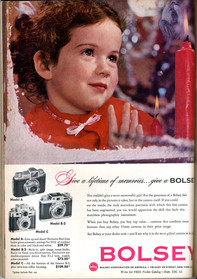


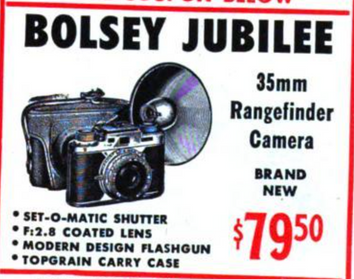


Quick Facts:
- Manufactured: 1955-56
- Shutter Speed: 1/10 -- 1/200 sec, B
- Focal Length: 45mm
- Aperture: f/4.8 -- f/4.28
- Original price: $79.50
- Film type: 35mm
- Shots per roll: 37 shots
For more information, reference the manual:
On the whole, while this camera has a bit of a learning curve in figuring out the dials, I do think this camera is a great introduction to vintage cameras and is a bit more photographer friendly than other point and shoots as there is more control over aperture and shutter speed.
If you have experience with this camera that you'd like to share, or any questions about topics discussed in this post, feel free to comment below!


Comments