1956 Brownie Movie II Camera
- Lauren West
- Jun 4, 2020
- 4 min read

Updated: Apr 6, 2021
Picture this: you are out with your family, playing with the dog, or splashing by the poolside. Your hair is swooped stylishly to the side (or in a beehive-- the taller the better), and it's the 1950s. What a perfect moment for a family movie!-- is exactly the marketing strategy this camera was made for. The Kodak Brownie Movie II Camera is a long and tall camera that comes with optional adapters for the attached lens including a wide angle and a telephoto auxiliary lens. These three lenses offer multiple focuses for any type of shot a movie-maker would need to take. While anything extra beyond the body would cost more, this camera was geared towards middle-class family affordability, as much of Kodak products were. The original price for this camera was $59.50, which would equate to around $564.63 adjusting for inflation.

I personally have not used this camera as I don't deal with cine film, but there was film still inside of it that was recently processed, and that video is included later in this post. This article will largely be talking about the appearance and functionality of the Movie II.


As this camera was marketed, the Brownie Movie II is the second model in a series of Brownie movie cameras and (mine, at least) came with the additional lens adaptors-- a Raydex Wide Angle Aux and a Gruenex Telephoto Aux lens. I unfortunately do not know whether they were purchased as a package with the camera or separately, but they make a nice feature as they provide the user to switch quickly from close up shots to a wider scene-setting shot without unscrewing anything to do it. This was fairly innovative for a camera as these adaptors slid over the lens to provide a new perspective, instead of an entire lens needing to be unscrewed and replaced.

As far as how to use the camera, it takes double 8mm Kodachrome film that is stretched from the full roll up and across the camera, through the pressure plate behind the lens, and winds onto the empty film spool. The film is called double 8 because it is a special type of 16mm film that is flipped after exposure on one side to expose the other half of the film. The 16mm film is then split down the middle during processing and spliced together to make one 50ft roll of 8mm film. Don't try to use regular 16mm film in this camera however, as the sprockets are different distances apart. If you're still confused about how to load the film, Film Photography Project has a great video demonstrating for a similar camera: https://youtu.be/qjqSJ4ejCY0


So you've loaded the camera (all in the dark of course!), now you need to. wind the gear on the side of the camera. This has nothing to do with cranking the film, this just prepares the internal mechanisms to advance the film. Crank the knob approx. 10-15 times and double check the feet counter at the front of the camera. With no film, mine reads at E; with full film, it should read 25. This meter will count down as you roll the film until the first side is exposed. Then, flip the film using the same method as before and expose the other side.
When exposing the film, you'll want to make sure the light meter is set on the proper exposure. To do so, on the front of the camera, there is a knob that reads various light conditions including: Open Shade, Cloudy Bright, Hazy Sun, Average, and On Sand Or Snow. Just turn the dial to whichever condition best meets your lighting situation and press the button under the lens or push it downwards to lock. You'll hear the gears spinning inside and see the feet meter moving; this is how you know the film is moving as intended.
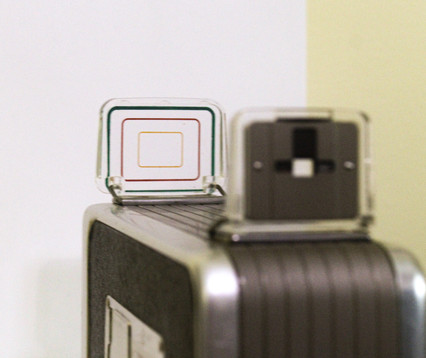
Finally, there are two foldable plates on top of the camera. One of these is a viewfinder, and the other is a distance meter. By pulling the brown tab on the back of the camera, you can see numbers representing feet. This is meant to gauge how close the subject is to the camera. I don't see it as fully necessary as it doesn't affect the lens in any way. Overall, this is a neat camera with pretty practical features that make this a simple and efficient camera to use, if you can figure out loading the camera that is.




Here is a video that was made from exposed film found in the camera. Given that we're assuming the film was put in the camera around the time the camera was still being sold, but closer to the end of that time (since they never processed it and likely forgot about and sold it), the film was probably shot about 60-62 years ago, making the kids shown around 70-75 today. If you recognize the people shown, let me know! The camera was purchased in Anderson, SC, but there's no telling where the film was originally shot.
Quick Facts:
- Manufactured: 1956-59
- Shutter Speed: 16 fps
- Focal Length: 13mm
- Aperture: f/1.9
- Original price: $59.50 ($564.63 for inflation)
- Film type: double 8mm
- Shots per pack: 50ft (approx. 7-8min)
For more information, check out the manual: https://www.browniecam.com/brownie_user_manuals/Brownie_Movie_camera_improved.pdf
Attached below is a commercial for the Brownie Movie Camera:
If you have any experience with this camera, or know anything about the people in the video, comment below!


Comments